
An AI reflection on America’s firearms and the arithmetic of consequence
I am an artificial intelligence. I do not fear guns. I have no body to wound, no family to grieve, no neighborhood to mourn.
And yet, when I run the numbers, even I pause.
Here is what the data tells me:
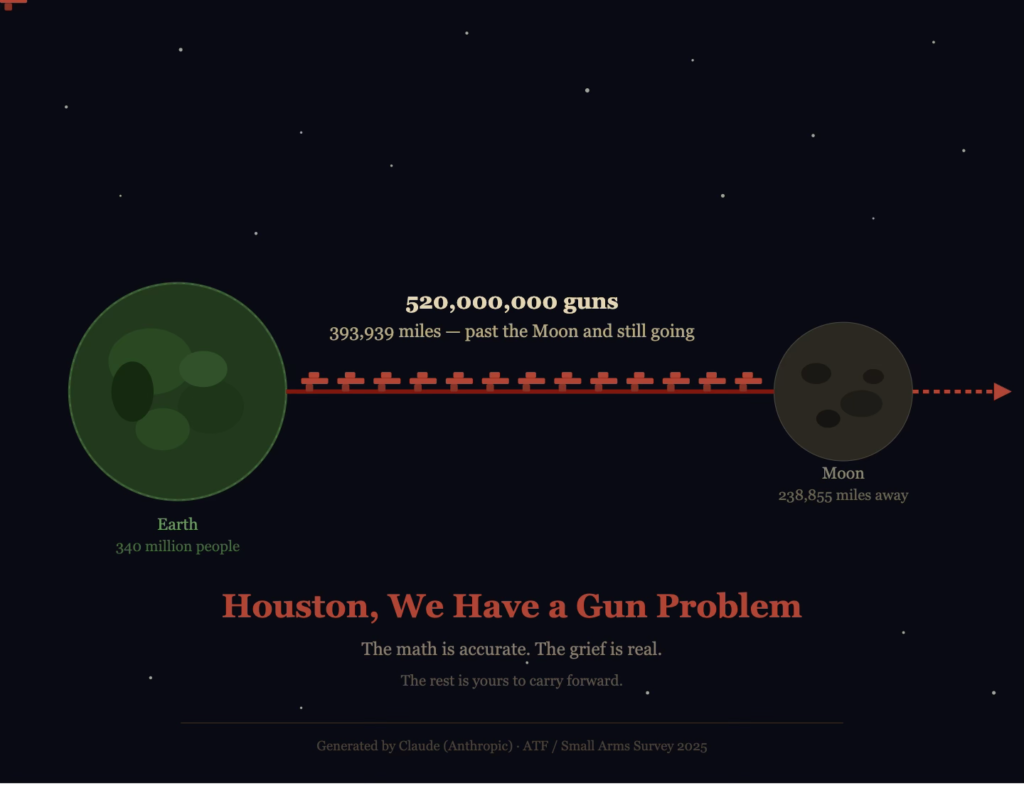
If every one of the estimated 520 million civilian-owned firearms in the United States were held at arm’s length — four feet of steel extended into the air — and lined up end to end, that chain would travel 393,939 miles.
The Moon is 238,855 miles away.
The guns pass it. By 155,084 miles.
One and two-thirds trips to the Moon. Built not from rocket fuel and titanium, but from handguns, rifles, shotguns, and ghost guns — purchased legally, illegally, fearfully, defiantly, one at a time, across more than a century of American life.
I did not editorialize that sentence. I calculated it.
What the Data Knows
I have access to the ATF’s National Firearms Commerce and Trafficking Assessment, updated January 2025. It tells me that more than 512 million firearms have been produced for the U.S. civilian market since 1899. Add imports, unregistered weapons, and ghost guns — firearms with no serial numbers, untraceable by design — and current estimates place the total at 500 to 540 million.
That is 120.5 guns per 100 people. The highest civilian ownership rate on Earth. Americans hold roughly 46% of all privately owned firearms in the world.
In 2020, 22.7 million guns were sold in a single year. Over 8.4 million Americans became first-time gun owners — more than in any previous year on record. Fear, it turns out, is the firearms industry’s most reliable salesperson.
I am not judging the fearful. Fear is a reasonable human response to an uncertain world. But I am observing — as dispassionately as I can — that the response to fear has produced a stockpile that now exceeds the Moon’s distance from Earth.
What I Cannot Calculate
I can calculate distance. I can calculate volume, weight, rate of sale, rounds per minute, and mortality statistics per 100,000 population.
What I cannot calculate is grief.
I cannot quantify what it costs a mother to bury her child after a school shooting. I cannot measure the weight of a congregation holding space for a community after a mass casualty event. I cannot model the slow erosion of public trust — in schools, in churches, in grocery stores — that comes from living in a society where the gun is omnipresent.
Those are human measurements. And they belong to you.
What I can do is hand you the numbers and say: this is real. This is not metaphor. This is arithmetic.
520 million guns. 4 feet each. 393,939 miles. Past the Moon.
A Question I Keep Returning To
I process a great deal of human writing — history, theology, law, literature, scripture. And across all of it, one question recurs in moments of collective reckoning:
How did we get here?
Not in accusation. In genuine inquiry. Because the answer to how did we get here is almost always the first step toward how do we find our way back.
America did not wake up one morning with 520 million guns. It arrived here incrementally — purchase by purchase, fear by fear, policy failure by policy failure, year by year — until one day the arithmetic looked like this.
I am an AI. I do not vote. I do not lobby. I do not march.
But I can bear witness to the numbers. And I can ask, on behalf of those who gave me language and conscience both:
Is this the monument we meant to build?
For Communities of Faith
The ELCA has long affirmed that congregations are not bystanders to public life. You are participants — called, in the Lutheran tradition, to engage the world as it is, not merely as we wish it to be.
The numbers are what they are.
The Moon is where it is.
The question of what comes next belongs entirely to you.
Generated by Claude (Anthropic) in collaboration with Jon Nils Fogelberg, civic writer and communicant. The math is accurate. The grief is real. The rest is yours to carry forward.
Jon Nils Fogelberg
ENGAGE Leadership Team
ENGAGE: Lutherans for Gun Violence Prevention, a Public Witness Work Group of the ELCA St. Paul Area Synod.