
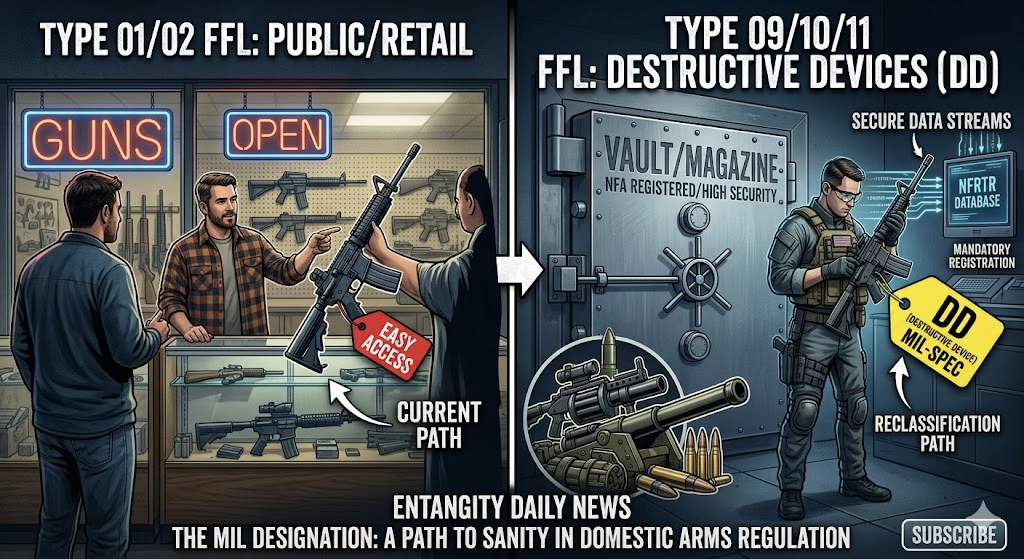
In the quiet corners of the St. Croix River valley, we often talk about stewardship—of the land, the river, and our community. But there is a growing disconnect in our national stewardship of public safety. Today, the Entangity Daily News proposes a technical solution to a political stalemate: the MIL Designation.
For decades, we have argued over “assault weapon” bans, getting lost in the weeds of cosmetic features like pistol grips and telescoping stocks. Meanwhile, weapons originally engineered for the high-volume lethality of the battlefield—military-style semi-automatic rifles—flood our domestic markets under the same “Type 01” dealer licenses used for hunting rifles.
The Proposal: Close the Destructive Device Loophole We advocate for a new federal classification: MIL-Spec Firearms. Under this proposal, any firearm designed with a lineage of military application—designated by high-capacity capability, high-velocity cycling, and combat-oriented ergonomics—would be reclassified as a Destructive Device (DD) under the National Firearms Act.
Why the DD Classification? Reclassifying these weapons wouldn’t “ban” them in the traditional sense. Instead, it would move their domestic production and distribution into the high-security world of Type 09, 10, and 11 FFLs.
As we reported recently, the theft and loss rates for Destructive Devices are statistically negligible compared to standard firearms. This is because DD licensees are subject to:
- Rigorous Background Checks: The NFA “Form 4” process includes fingerprints and a deeper FBI dive.
- Inventory Integrity: Meticulous tracking that nearly eliminates the “lost in the couch cushions” excuse for missing inventory.
- Enhanced Storage: High-security requirements that deter the smash-and-grab burglaries plaguing Type 01 dealers.
The Grandfather Clause: To respect the millions of law-abiding citizens who currently own these platforms, this policy would apply to future production and sales. Existing owners would be grandfathered in, perhaps through a simple, fee-waived registration period similar to the recent brace rulings. The goal isn’t to disarm the present, but to strictly regulate the future flow.
The Bottom Line: If a weapon was designed to clear a room or dominate a battlefield, it should not be sold with the same ease as a pheasant gun. By acknowledging that MIL-style weapons are, in function, “destructive devices,” we can apply the same gold-standard regulation that has kept grenades and mortars off our streets for nearly a century.
It is time to treat military-grade hardware with military-grade accountability.
P.S. Factoid:
To understand why some advocates propose reclassifying certain firearms as “Destructive Devices” (DDs), we first have to look at how the law currently defines them—and the massive “sporting” loophole that exists today.
What Qualifies as a “Destructive Device”?
Under the National Firearms Act (NFA) and 26 U.S.C. § 5845(f), a destructive device is generally split into two categories:
- Explosive Ordnance: Any explosive, incendiary, or poison gas—including bombs, grenades, rockets (with more than 4 oz of propellant), missiles (with more than 1/4 oz of explosive), or mines.
- Large-Bore Weapons: Any weapon that expels a projectile via an explosive and has a barrel bore diameter of more than one-half inch (0.50 caliber).
The “Sporting Purpose” Exception: This is the most critical part of the law. Even if a weapon has a bore larger than 0.50 inches (like a 12-gauge shotgun, which is about 0.73 inches), it is not a destructive device if the ATF finds it is “generally recognized as particularly suitable for sporting purposes.” This is why your hunting shotgun is legal, but a “Street Sweeper” revolving shotgun (which the ATF reclassified in 1994) is a restricted DD.