
What we are willing to spend to protect life reveals what we believe life is worth
On April 10, 2026, four human beings rode fire into the sky and came home alive.
That sentence alone is a miracle of engineering, discipline, and—above all—intentional care.
For Artemis II, NASA layered safety upon safety. Abort systems. Emergency egress. Redundant detection. Reinforced shielding. Life-support systems designed to anticipate failure before it happens.
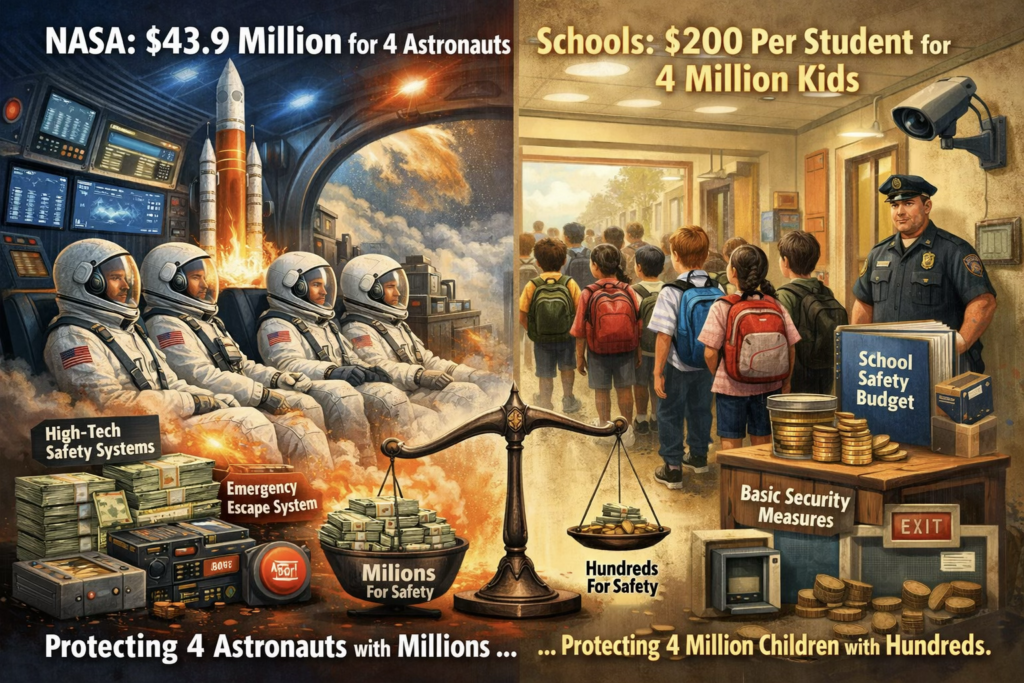
From public data, we can point to at least $43.9 million in clearly identified, crew-safety-specific investments—and that’s only what is cleanly itemized. The true investment in keeping those four astronauts alive is undoubtedly higher.
Pause there.
Four people.
Tens of millions of dollars.
Zero tolerance for preventable loss.
Now, let’s gently shift the lens.
The Classroom
In the United States, there are roughly 50 million public school students.
Every morning, they walk into buildings that—unlike spacecraft—were not designed from the ground up for life-or-death contingency planning.
Over the past decade, schools have added layers of protection:
- secured entrances
- surveillance systems
- school resource officers
- active shooter drills
- mental health programs
- threat assessment teams
Estimates vary widely, but a commonly cited range places school security spending at roughly $100–300 per student per year in many districts, sometimes higher in urban or high-risk areas.
Let’s take a midpoint for illustration: $200 per student annually.
Multiply that:
- 50 million students × $200 = $10 billion per year
That sounds like a large number.
Until you look closer.
The Comparison That Isn’t Comfortable
NASA spent tens of millions to protect four lives on a single mission.
Schools spend, on average, a few hundred dollars per year to protect each child in an environment of persistent risk.
The ratio is not the point.
The intent is.
NASA operates under a philosophy that might be summarized this way:
If a risk can be anticipated, it must be engineered out.
Failure is studied in advance.
Redundancy is built in.
Human life is treated as irreplaceable.
Now ask yourself—quietly, honestly:
Do we apply that same philosophy to our children?
The Hidden Difference
This is not a critique of schools.
It is a critique of how systems form.
Space missions are finite, bounded, and unified:
- one agency
- one chain of command
- one mission objective
- one budget
Schools are the opposite:
- 13,000+ districts
- fragmented funding
- competing priorities
- political constraints
- local variation
In one system, responsibility is centralized and absolute.
In the other, it is distributed and negotiable.
And when responsibility diffuses, so does urgency.
The Entangled Reality
There is a deeper pattern here.
When four astronauts strap into a rocket, the entire nation understands:
their fate is tied to our collective effort.
We feel the connection.
We see it.
We fund it.
But in a school hallway, that same connection is quieter.
Less visible.
Less cinematic.
Easier to compartmentalize.
And yet—if we step back—the truth is unmistakable:
Every child is part of the same shared system.
Their safety is not local.
It is national.
It is relational.
What Would It Look Like to Decide Differently?
Not more fear.
Not more drills.
Not more reactive measures alone.
But a shift in mindset:
From:
“How much security can we afford?”
To:
“What level of risk is unacceptable—and how do we design it out?”
That could mean:
- smarter building design (single-point entry by default)
- integrated detection systems, not piecemeal upgrades
- standardized national safety baselines
- proactive behavioral threat systems that work across districts
- consistent funding models, not grant-driven patchwork
In other words:
Treat schools less like institutions to manage
and more like missions to protect.
The Quiet Question
NASA did not ask whether those four astronauts were “worth” the cost.
That question never appears in the equation.
The only question is:
What must be done to bring them home safely?
Closing
If something here feels uncomfortable, it should.
Not because anyone is failing.
But because comparison reveals something deeper than numbers.
It reveals priorities.
And priorities—once seen—have a way of asking to be reconsidered.
If something here stirred you, don’t let it end on the page.
Join the deeper exploration at ENGAGE ELCA — where these ideas are being shaped into real-world pathways:
👉 https://engageelca.org